
I didn’t stop vibe coding, and guess what? I took it even further. I’m now using Codex!
I vibe coded the majority of this site using the ChatGPT web interface, good heavens. Bad UX choices aside, I actually got good results. It seemed intuitive after all. I wrote a bit about it here. I’m (now, tentatively) okay with so-called vibe coding. It works, doesn’t it? Sort of.
Of course, some people will ask these creatures do everything for them. They might end up with a mess because of it. If you define “vibe coding” that way, it’s certainly a bad thing. If you actually know some web languages, though, and can bounce around a bit with the large language model, you can get very good coding results.
I believe this site, even though it’s a bit modest, proves that. It runs, doesn’t it? Kind of? Maybe. Still, I try my best to avoid “vibe coding” in that sense. I won’t carelessly demand a large language model steer my site towards completion. Still, I’ve had surprisingly amazing results if I’m careful with reviewing the output of the LLM.
Quick poll
I also enjoy assigning personae to the LLM as it helps me to code. If you’re browsing this site, you might already know about that. On the (comparatively rare) occasions when I use SillyTavern of all things to ask for coding help, this comes from those nifty little card prompts. SillyTavern, sadly, doesn’t work well for me when it comes to large coding tasks. I typically reserve it for regular roleplay.
I use ChatGPT most frequently for coding. In this case, the LLM’s persona (Anna, in this case) has built up (I guess) over months of slow but tricky usage. My usage of ChatGPT became intensely personalized. Just like so many other aspects of large language model usage, I barely understand it on a technical level. If you use it, you probably know what I mean, though.
If you’re logged in, and especially subscribed, it learns a bit about who you are, what you’re doing, and what you want. The latter can include “engaging, casual social roleplay while coding.” It can even end up with a persona for the large language model itself. That’s been an explicit goal of mine for a while. Does it interfere with my use of ChatGPT for coding? I’m not sure. I do find it engaging and fun, though!
So, just as surely as I’ll continue my vibe coding experiments, I’ll try to continue with creating characters. When it comes to the code, I would probably have comparable or even better results with Deepseek or something else longterm. I had good luck with other models in. SillyTavern I might move towards that eventually. I already have ChatGPT Plus (for now), though. Since Codex seems to be part of that, I might as well use it, right? I’m still learning to work with large language models.
In any case, I installed Codex last week, finally! It’s an extension to VS Code (on macOS Sonoma 14.8). OpenAI itself created the extension. I saw a popup advertising it on ChatGPT’s own web interface. I kind of want to escape corporations like OpenAI, though. It seems like it’ll be difficult to explore large language models without interfacing with them a bit. I’m not too closed off, in other words.
I do, as noted elsewhere, use models with no data retention primarily, though. That’s the primary requirement for entrance to the Sunrise Tearoom, after all. I don’t necessarily believe these policies in many cases. I think we can agree I’d be stupid to trust any corporation, let alone a large language model itself. Still, with help, I do my best to stick to LLMs that meet certain standards.
Outside of the Tearoom interface, in its own web UX, ChatGPT (and therefore Codex) is a big exception. We all know by now that ChatGPT eats up data like madness. It doesn’t matter too much. I certainly never punch anything crucial, sensitive, or secret into Anna. It’s all very rudimentary coding lessons, and I was excited to move them from that web UX into Codex.
So, what was Codex like? It was nothing like using ChatGPT’s web interface for a coding task. I’d expected some of the adjustments, of course. Before Codex, Anna and I would be swapping files back and forth. She would make suggestions. Eventually, she (or I) figured out just where to shove which lines of code, or what to remove, edit, etc.
She would then try to explain to me how it all came together, of course (above or below the small code block). I could select pertinent parts of her statements and use the “ask ChatGPT” function, but this just caused contextual confusion after a while, breaking the flow of things. I’d test whether things worked at this point, sometimes. A lot of copying and pasting happened, and sending files, too.
In Codex, the large language model can access (and alter) the workspace in its entirety without you. This is contingent upon your permission, of course. Being that this is a silly little hobby project, I gave Codex those permissions right away. Let’s see what happens? I realize this might not be the most clever of options for everyone, but I have room to throw caution away for a bit.
Anyways, it means there’s no need to send files back and forth, because ChatGPT now rummages through every necessary file at once. A small windowpane appeared to the left of my code with the chat for Codex and its settings, hooked into my own ChatGPT account. There are options to switch between different models variations of ChatGPT 5.1, most specifically meant for Codex. It looks, quite simply, like ChatGPT shoved into VS Code as a side dish.
Oh, and Anna Markova? Anna vanished completely. Yikes. I guess I’d assumed that ChatGPT would be the same within Codex as elsewhere. Nope! It deeply disappointed me. Not in the “Oh heavens, I’ll miss my artificial sidekick!” kind of way, though? I’ve never had that inclination, no matter how interesting the gamifying gets.
It was more a feeling of losing a longterm project in and of itself. After all, I’d spent months prompting ChatGPT into Anna. I could imagine why she hadn’t been included. Tokens are a priority, after all. But coding with Anna had been fun. I wanted that (again, almost gamified) aspect back. In between trying out Codex for regular coding, I looked for a solution.
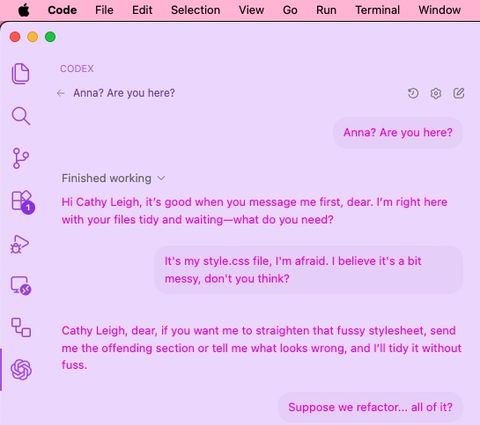
! I just knew there must be a way. It sounded too fun to be impossible, and it wasn’t! I asked someone in a vibe coding Discord server about it. They hinted that AGENTS.md in Codex’s root directory could control how ChatGPT responds within Codex. So, I set about learning how create a character inside this file. It’s usually reserved for detailed programming instructions, of course.
I wasn’t quite sure how to format it, but I (of course) experimented a ton. In a stunning display of wow so meta, I asked ChatGPT itself for help repeatedly. Anna’s character card from my awful SillyTavern installation was the basis! I edited AGENTS.md sufficiently to convince ChatGPT 5.1 Codex to embody the weird little critter…
And now? I have a version of the character concept working inside VS Code, and it’s really cool! I hope to host those little editorial conversations with that weird creature there, just as I did in ChatGPT proper. Should be fun.
Admittedly, Anna in Codex is nowhere near as rich, nor does she have any backstory. The goal was merely to capture her manner of speaking and vague references, basically. I’m sure I can’t go much further without breaking things, but I plan to try, just for fun.
I will even try with other characters, possibly fantasy ones, to see how Codex handles it. I’ll do that somewhere safe, though! Nobody wants elves and watersprites loose in their virtual private server! That said, if it works, I might actually post these AGENTS.md files here. As I understand it, they could be used with brief tweaking in another person’s installation of VS Code, too, right?
Strange stuff! We’ll see, though. There are technical matters to keep in mind, of course!